PR Tips

Keep up with what's happening at Judge PR. Every now and then, we stop and write some headlines of our own.

In a Fragmented, AI Driven Marketplace, Trust Has Become the Hardest Working Asset in B2B Marketing

B2B marketing is no longer a battle for attention. It is a battle for credibility.

As buying decisions grow more complex and artificial intelligence reshapes how companies are researched and evaluated, trust has emerged as the defining advantage separating market leaders from noise.

The traditional concept of a predictable buyer journey has collapsed. Today’s enterprise decisions are shaped by cautious CFOs, expanding procurement committees, generational shifts in research behavior and AI systems that surface brands before sales teams ever enter the conversation.

In this environment, reputation is often the first and most powerful sales touchpoint.

“When a potential client is researching your company, that moment is your first impression, your first meeting and your first pitch all at once,” said James Judge, founder and CEO of Judge PR & Marketing. “If trust is not established immediately through what they see, read and hear about your brand, you have already lost the opportunity. Trust is no longer part of the sales process. It is the entry point.”

Executives report that large contracts are increasingly stalled not by pricing or product features, but by uncertainty. When leadership teams struggle to reach consensus, the company perceived as most credible often advances. Trust accelerates the shortlist, reduces friction and lowers perceived risk.

Far from being intangible, trust can be measured through brand perception data, earned media authority, community advocacy and executive visibility. Organizations that treat credibility as a commercial metric rather than a marketing aspiration are seeing stronger pipeline velocity and higher win rates.

Authenticity is fueling that credibility.

Business audiences have grown deeply skeptical of overly polished messaging. They are navigating an ecosystem flooded with automated content and templated outreach. As a result, depth now outperforms volume. Decision makers are responding to brands that reveal process, perspective and real world experience.

At the same time, digital native buyers are redefining engagement. They are consulting AI platforms, participating in peer communities and validating decisions independently before engaging with companies directly. Transparency and accessibility are replacing traditional targeting strategies.

Community has become one of the most influential marketing channels in B2B. Peer voices and shared ecosystems are shaping perception more powerfully than paid campaigns, while brand building and demand generation are converging to drive both immediate and long term growth.

Artificial intelligence remains a powerful tool, but it is not the storyteller. Human insight, authenticity and strategic judgment continue to differentiate brands in a saturated content landscape.

The result is clear. In a market where buyers self educate and skepticism is high, visibility alone is not enough.

Credibility wins.

The next era of B2B marketing will belong to the organizations that earn trust before they ask for business.

For more information about building measurable brand authority and commercial trust, contact Judge PR & Marketing at 1.844.JUDGEPR 

About Judge Public Relations
Judge PR & Marketing is a full-service public relations, marketing and advertising agency specializing in AI-powered PR, digital marketing, traditional advertising, media relations and creative services. With a footprint across Florida, Georgia, South Carolina, North Carolina, Tennessee, Washington, D.C., and the Caribbean, the firm delivers tailored solutions for diverse industries. 

Christy MonahanIn a Fragmented, AI Driven Marketplace, Trust Has Become the Hardest Working Asset in B2B Marketing
Read More

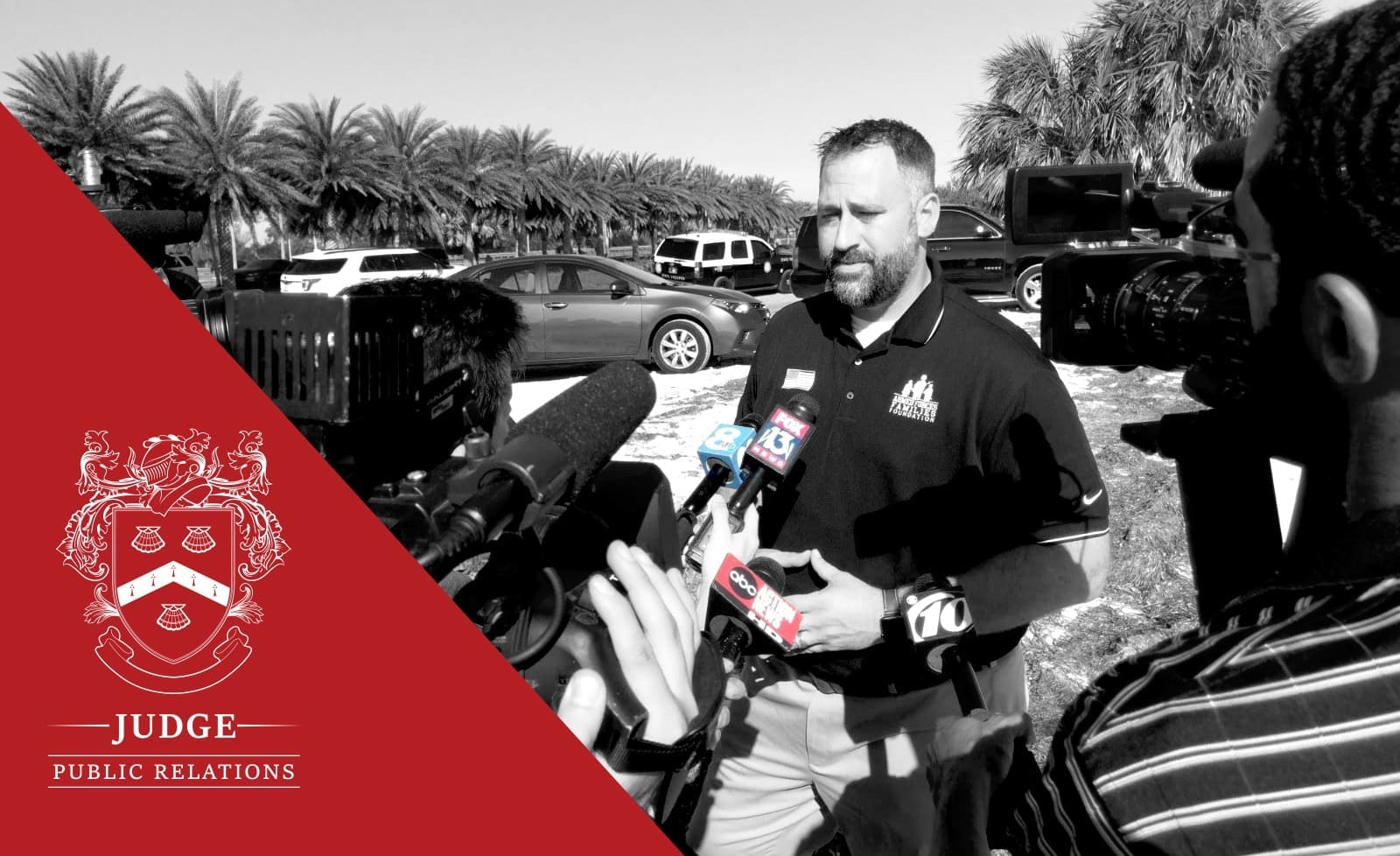
Top 10 Tips to know Before Talking to the Media

Here are 10 tips from Judge Public Relations to help you out when it comes to dealing with a member of the media. These interview tips can apply to crisis communications or are applicable in every-day use when handling an interview request from the media.

  1. NEVER EVER say “no comment.” Saying “no comment” implies guilt. If you can’t comment on something for a specific reason or don’t feel like commenting, you should say why. When the media asks for your comment, it’s an opportunity for you to tell your side of the story. Don’t waste this opportunity by saying “no comment.” The odds are good that your “no comment” will be used in their story and you’ll look guilty by refusing to talk. 
  2. NEVER speak “off-the-record.” While terms like off-the-record, on-background, deep-background, unattributable, and more, are common terms in journalism, it’s a better practice to just assume that whatever you say could wind up in the news when you are speaking with a reporter. If you practice that whatever you say could wind up in the news, you won’t be surprised when it does. 

  3. Always tell the truth. Credibility is the most important thing you have and if you lose your credibility, it can take years to get it back, if you’re ever able to get it back at all. Always tell the truth and if you made a mistake or your company made a mistake, admit when you are wrong, tell people that you made a mistake, apologize, and express how you plan on correcting that mistake to make sure it doesn’t happen again.
  4. Never assume the camera is off. This is generally a very good idea, and similar to our #2 tip. Always speak like you’re speaking on the record. You don’t want to create more issues by saying something on-camera that you’ll regret.
  5. Try to be confident and relaxed. Don’t be confrontational and try not to appear nervous when speaking to the media. It doesn’t look good on-camera and body language is important when it comes to conveying your message. Additionally, if the media is interviewing you, it is most likely because you are the subject matter expert. You are most likely not going to have to answer any questions you haven’t already answered before. 
  6. Keep answers simple and concise. These days, our entire world is broken down into soundbites and quotes and everyone is preoccupied by the next shiny object to distract them from whatever they’re currently doing. Try to ensure your message is heard by breaking things down in simple terms, avoiding slang or jargon that may not be understood by the general public, and expressing your message in the shortest way possible. 
  7. If you make a mistake, say so and correct it. When you’re giving an interview, make sure that the information you provide the journalist with is accurate, and if you make a mistake, say so and make sure to get the correct information to that reporter. The last thing a reporter wants is for their story to be inaccurate because of something you told them. They genuinely want to get their story right, so make sure to help them to tell an accurate story. If you burn a reporter by lying to them or not correcting false information, it will be unlikely that they will want to use you a source again.
  8. Follow yes/no answers with an explanation. Yes or no answers don’t make for good soundbites or quotes. Make sure to follow up your yes or no answer with a brief explanation.  


  9. Don’t be defensive. Coming across as defensive can make you appear guilty, even if you’re not. Always be polite, respectful and courteous. 
  10. CALL 1-844-JUDGEPR FOR MORE TIPS!

Judge Public Relations is a PR firm located in Tampa, Florida. Founded in 2011, Judge PR is a Service Disabled Veteran Owned Small Business certified by the U.S. Department of Veterans Affairs. Judge PR represents a wide variety of clients from around the world and has worked with members of the media on every continent.

jpr_joshTop 10 Tips to know Before Talking to the Media
Read More